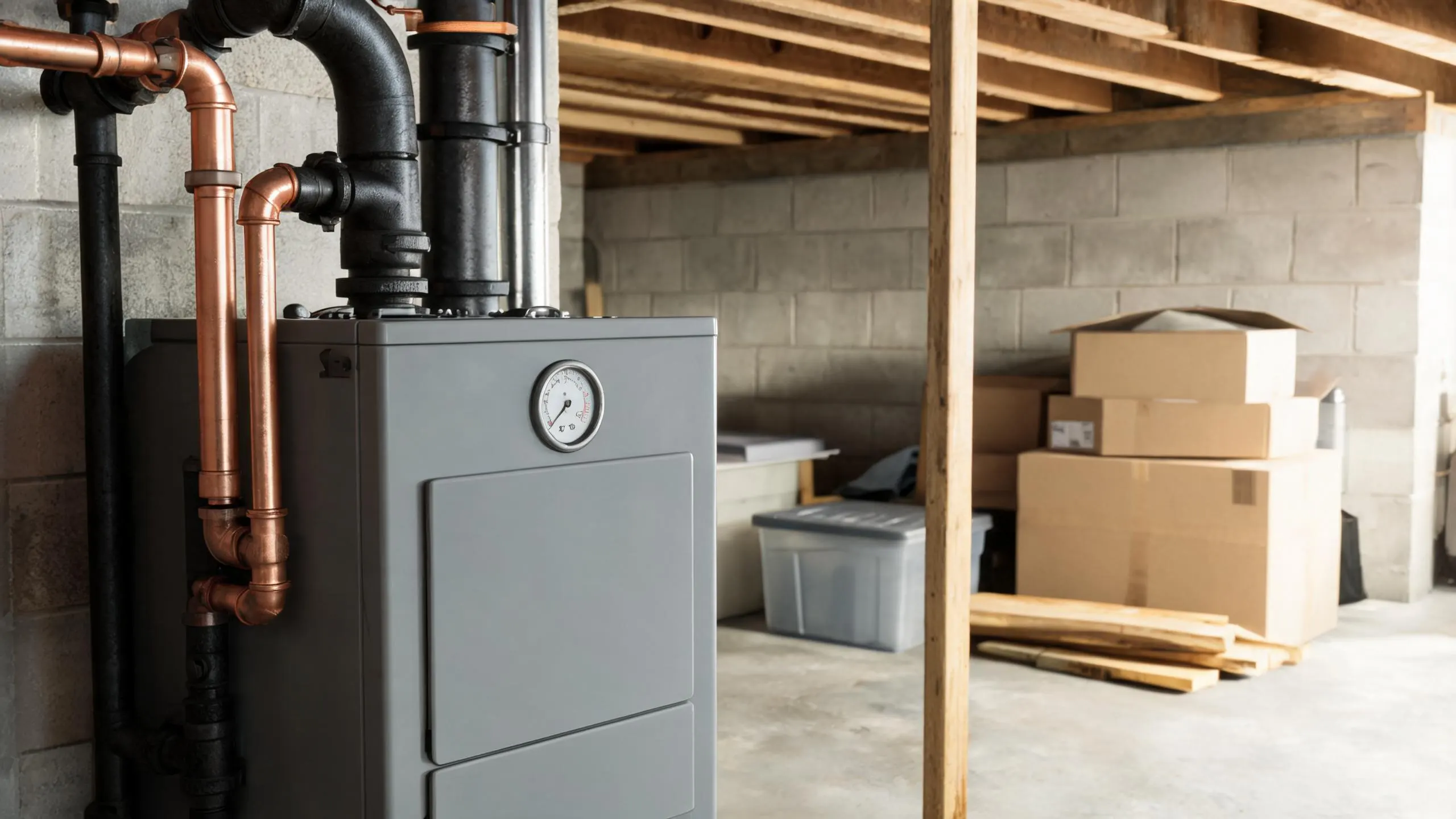
A gray boiler with copper and black piping mounted against a concrete block wall in an unfinished basement.

Boiler Repair in Conway, NH

Tell us about the job

Takes about a minute. No obligation.

RepairBoilerCarroll County, NH
Step 1 of 2

What ZIP code is the job in?

Kettling or banging means the boiler needs attention

A boiler that bangs, knocks, or makes a kettle-like rumbling sound usually has sediment built up on the heat exchanger. The noise comes from water trying to move past the buildup. Left alone, the heat exchanger works harder than it should and can crack from the stress.


Cold radiators or rooms tell you where to look first

If some radiators heat up and others stay cold, the problem is usually trapped air or a stuck valve, not the boiler itself. If nothing is heating at all, check the pressure gauge and the pilot or ignition before assuming the worst. A contractor will want to know which rooms are affected when you call.

Fuel oil in New Hampshire ran $24.23 per million Btu in 2024.

A boiler with sediment or a stuck valve burns that oil to heat less of your house, so the fix pays for itself the longer you wait.

Carroll County sees 214 severe weather events a decade. Have your boiler's vent and flue checked after any bad one.

214 severe weather events from 2015 to 2024
22% of homes statewide lost power a day or more in 2024
70 damaging wind events from 2015 to 2024
Half this county's homes aren't old enough to worry about yetHalf the homes in Carroll County were built in 1982 or later.

Boilers in Carroll County sit idle all summer and start the season again in September, so August is the month to check yours. A part that was already weak doesn't show it while the boiler is off. It shows it the first cold week, when the burner is running long hours instead of short ones. A valve that barely held last spring, or a heat exchanger with sediment on it, tends to fail right at that point, not later in the winter. Heat runs here nine months, September through May, so a boiler that starts the season weak stays weak for most of the year. Having it looked at in August, before it has to work, catches that kind of problem while it's still small.

Nine months of heat a year adds up. Get the real cause found.

Heat runs here from September through May, with overnight lows averaging 12°F in the worst of winter. That's a long stretch for a boiler to carry, and it's usually why a part gives out now instead of later. Have it diagnosed before you pay to fix the wrong thing.

Find a contractor
A man in a cap, dusty dark shirt and work pants walks up stone steps toward a dark navy front door, carrying a worn canvas tool bag, with a potted shrub beside the entry.

Check the pressure gauge first

A boiler that has lost pressure will lock out or run without heating properly. The gauge tells you where it stands, and most have a marked zone showing what's normal. If it's low, you can often repressurize it yourself using the filling loop, if you know where that is. If the pressure keeps dropping over the following days, something is leaking, and that part isn't a homeowner fix.

Listen for what's actually happening before you call

Note which rooms are cold, whether the boiler fires at all, and whether you hear banging or just silence. A contractor asks these same questions when you call. Having the answers ready means less time spent diagnosing over the phone and more time spent fixing the actual problem.

Most boiler failures trace back to a handful of parts, not the boiler as a whole. The heat exchanger fails from sediment buildup over years, the same buildup that causes kettling. An ignition module or pilot assembly wears out and stops lighting the burner reliably. Circulator pumps seize or wear out their bearings, usually announced by a humming sound with no water movement. Pressure relief valves and expansion tanks fail quietly, showing up only as pressure that won't hold. Seals and gaskets around unions and valve bodies dry out over time and start weeping, which is often the first sign anyone sees. None of these mean the boiler itself is done. Most are a single part doing exactly what worn parts do.

A diagnostic visit starts with the questions you already have answers to. Which rooms are cold, whether it fires at all, what the pressure gauge reads. From there the tech checks pressure and looks for signs of a leak. A boiler that won't hold pressure keeps coming back no matter what else gets fixed. If it fires but doesn't heat evenly, the next check is usually the circulator pump, listening for it running without moving water. Banging or kettling points toward the heat exchanger, and that usually means draining it to see how much sediment has built up inside. If the boiler isn't lighting at all, or lights and then cuts out, the ignition or pilot assembly gets checked next. By the end, the tech should be able to point to the one part causing the problem rather than guessing at the boiler as a whole.