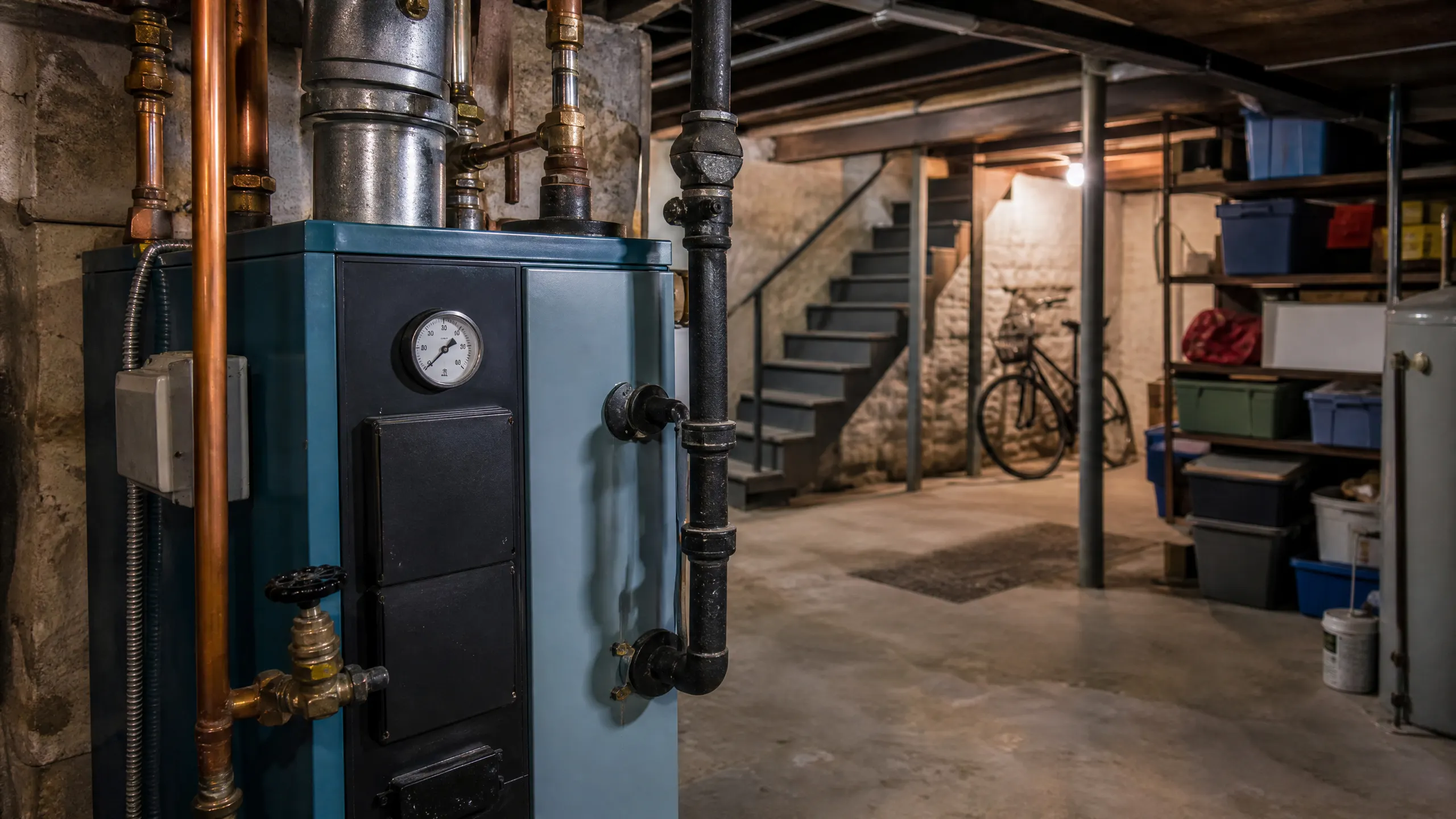



A residential basement showing a blue boiler with copper and iron pipework in the foreground, with storage shelves, a bicycle, and a staircase in the background.

Boiler Repair in Laconia, NH

Tell us about the job

Takes about a minute. No obligation.

RepairBoilerBelknap County, NH
Step 1 of 2

What ZIP code is the job in?

A boiler in Laconia runs from September through May, close to nine months straight. Overnight lows average 14°F across December, January and February, and the boiler is what keeps a house livable through that stretch. Add in how many winter storms pass through this county most years, and the system rarely gets a real break once cold weather sets in. That kind of use wears on a heat exchanger, a circulator pump, an ignitor, the parts that cycle on and off all day for months at a time. When something starts acting up, it's worth having a licensed contractor look at the actual cause rather than just quieting the symptom, so the fix holds for the rest of the season.

Half the homes in Belknap County were built in 1979 or later.

A boiler in a newer house still has working life in it, even with the hard use winter here puts on it, and that makes repair worth doing.

Oil here runs $24.23 per million Btu, and a boiler that's struggling burns through more of it every month it goes unfixed

Heat runs September through May
Winter nights average 14°F
44 winter storms from 2015 to 2024

A boiler that's cycling on and off all winter doesn't give a loose wire or a dirty sensor much chance to show itself. The system just works harder around the problem until something fails outright, and with 44 winter storms moving through this county over the past ten years, that failure tends to land at the worst time. A licensed contractor can check the ignitor, the pump and the exchanger while the system is still running, not after it quits. If the boiler is already acting up now, that's the point to have it looked at, before the next storm is the thing forcing the issue.

Get it checked before September puts the load back on it

Heat starts running here in September. Whatever's making the boiler act up now will be carrying the full load within weeks, not easing into it. Have it looked at in August, before the first cold snap finds the weak part for you.

Find a contractor

A small leak turns into a cracked exchanger

A pinhole leak at a fitting or valve doesn't stay small just because the boiler keeps running. Minerals in the water left behind by that leak build up on the heat exchanger, and the metal starts to heat unevenly. Run it long enough that way and the exchanger cracks instead of just needing a new gasket.
A failing part makes the ones around it fail too

A circulator pump that's starting to stick still forces water through the system, just not enough of it. The boiler keeps firing to make up the difference, short-cycling more than it should, and that extra cycling wears on the ignitor and the control board. What started as one weak pump ends up taking other parts down with it.

A boiler that needs attention usually says so through sound and smell before it quits outright. A knocking or banging from the heat exchanger often means mineral buildup or trapped air, not something that fixes itself by running longer. A burning or metallic smell near the unit is worth stopping for right away. Water pooling at the base points to a failed valve or a crack, and it only gets worse from there. If the system is cycling on and off more than it used to, or taking longer to bring the house up to temperature, the ignitor or the circulator pump is usually behind it. Pay attention to uneven heat too, warm in one room and cold in the next, since that often means water isn't moving through the system the way it should.

A diagnostic visit starts before any panel comes off. A contractor will ask what the system is doing, when it started, and whether it's constant or comes and goes, because that narrows things down fast. Then it's a look at pressure, at the flue, at the water around the base, before anything gets taken apart. Gauges come next, checking pressure through a firing cycle and the temperature of the water going out and coming back. A thermocouple or flame sensor gets tested under power, not just looked at, since a part can look fine and still fail to hold a signal. If the heat exchanger is the suspect, that means checking for soot, for uneven scorch marks, for anything that points to a crack rather than just buildup. The goal is to find which part is actually failing, not just the one that's loudest about it.