




White colonial-style houses with lit windows photographed at dusk along a tree-lined street.

Furnace Repair in Dover, NH

Tell us about the job

Takes about a minute. No obligation.

RepairFurnace or heatingStrafford County, NH
Step 1 of 2

What ZIP code is the job in?

Furnaces in Dover run from October through May, close to eight months of the year. Overnight lows in Strafford County average 16°F across December, January and February, so the furnace isn't just running often, it's working against real cold. Winter storms roll through on top of that, and the system rarely gets an easy stretch. All that runtime adds up on the igniter, the blower motor, the heat exchanger. A furnace carrying this kind of load will show problems sooner than one in a milder state, and a strange noise or a short cycle now is worth taking seriously.

8 months
October through May, your furnace is on duty
16°F
the average winter night it heats against
44 winter storms
in ten years, the nights a failure hurts most
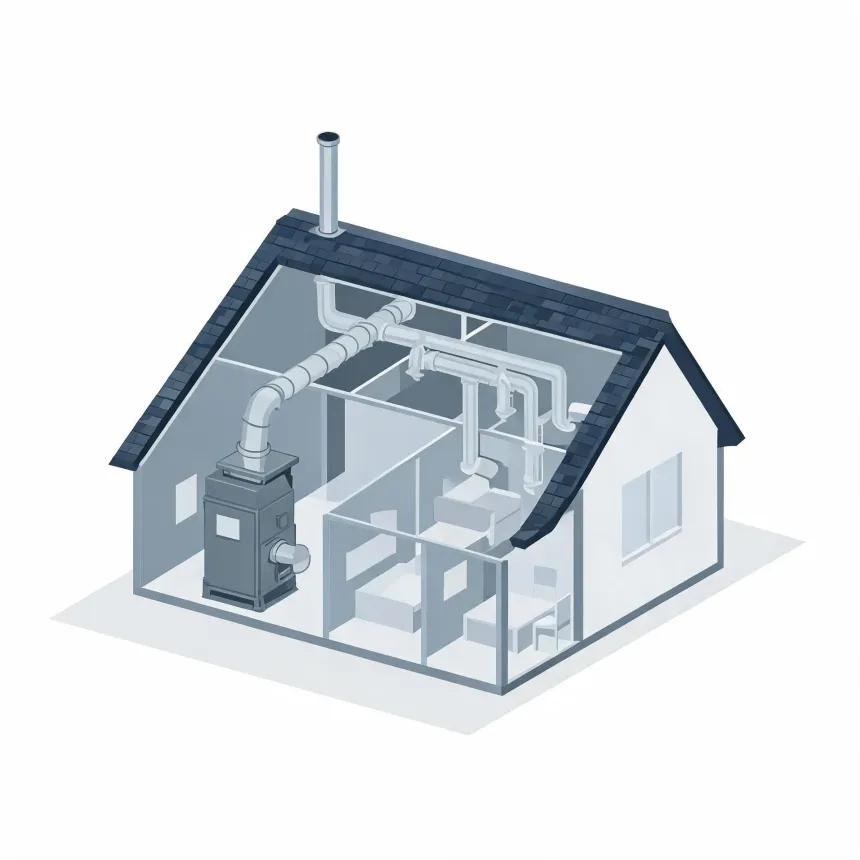
Isometric cutaway illustration of a small house showing a gray furnace unit with a flue pipe through the roof and branching ductwork running to rooms with simple furniture.
Your furnace works hardest from November through March.

NOAA nClimDiv, 1991–2020 normals

A furnace that shuts off before the house warms up is short cycling.

A dirty flame sensor or a clogged filter usually causes it, and leaving it alone can take out the igniter next.

Furnace trouble in Dover tends to start in October, right out of the gate

Heat runs October through May
Winter nights average 16°F
44 winter storms from 2015 to 2024

Age is the first thing to weigh, but it isn't the only one. A furnace near the end of its expected life that needs a new heat exchanger is usually done, since that part alone can cost close to what a new system runs. A furnace in its early or middle years with a failed igniter or a bad pressure switch is a different story. That's a part swap, not a system problem. The pattern that should worry you is repairs stacking up, one part fixed this year and another next year, because that usually means the parts around them are wearing out too. A tech who's run the furnace through a full cycle and looked at what's failing can tell you which situation you're in. Guessing from the symptoms alone can't.

Fuel oil in New Hampshire runs $24.23 per million Btu

That's what it cost on average in 2024. A furnace running rough burns through that faster than it should, every month it's left alone. If yours is short cycling or making a noise it didn't used to make, get it looked at before another cold stretch runs up the bill.

Find a contractor
A man in a cap, dark shirt and tan work pants, seen from behind, carries a worn canvas tool bag up steps toward a dark blue front door beside a tall planter of flowers.
A gray high-efficiency gas furnace installed in an unfinished basement, surrounded by gas lines, a condensate drain, and sheet-metal ductwork.

No easy stretch to recover in

Eight months of heat, nights near 16°F, and a storm hitting Strafford County every couple months in winter. That's the load this furnace carries, and it's why a noise or a short cycle now is worth a real diagnosis instead of a guess. A tech can check the flame sensor, the igniter and the pressure switch in one visit and tell you which one is giving out. Catching it there is what keeps a small part from taking the furnace down in the middle of a storm.

Most failures are one part, not the furnace

The igniter wears out from repeated heating and cooling cycles. The flame sensor coats with residue until it can't detect the flame and shuts the burner down. A pressure switch sticks or fails and stops the furnace from starting at all. Any one of these can take the whole system offline, but replacing that single part is usually all it takes.
Airflow problems cause the damage that follows

A clogged filter or blocked vent restricts airflow across the heat exchanger, and the furnace starts running hotter than it should. That heat cycles the limit switch on and off, wears down the blower motor, and over time can crack the heat exchanger itself. Most of what starts as an airflow issue ends up looking like a part failure somewhere downstream.

Before calling anyone, check the filter. Pull it out and hold it up to a light. If you can't see through it, swap it, and if you don't know how old it is, assume it's overdue. Next, look at the vents and returns in each room and make sure none are blocked by furniture or rugs. At the thermostat, change the batteries if it uses them, and confirm it's set to heat and not fan only. Check the furnace switch, the one that looks like a light switch near the unit, and make sure it hasn't been bumped off. If the furnace runs on gas, check that the gas valve is open and that the pilot or igniter is actually lighting when it cycles on. None of this fixes a cracked heat exchanger or a failing blower motor, but it rules out the simple stuff before a tech has to.

A diagnostic visit starts with questions, not tools. The tech wants to know what the furnace is doing, when it started, whether it's a smell, a noise, or a cycle that won't finish. That narrows things down before the cover even comes off. Once it's off, the tech watches the furnace run through a full cycle. Ignition, burner flame, blower kicking in, shutdown at the thermostat's call. A multimeter checks the flame sensor's signal and the igniter's resistance, since both can look fine and still be failing underneath. They'll also check static pressure in the ductwork, because high pressure usually points to a blocked filter or a closed vent, not a broken part. Only after all that does a tech say what's actually wrong. Guessing from a noise over the phone gets it wrong often enough that nobody worth hiring will quote a repair without seeing the furnace run first.