A two-story brick house with black shutters and a covered porch stands on a mown lawn behind large deciduous trees, with a dry-stacked stone wall running across the foreground.

Mini Split Installation in Concord, NH

Tell us about the job

Takes about a minute. No obligation.

New system or replacementMini-splitMerrimack County, NH
Step 1 of 2

What ZIP code is the job in?

What happens to the old equipment depends on what it is

A window unit comes out and gets hauled away. Baseboard heaters get disconnected and removed too. If the home has ducted central air or a furnace, that equipment is often left in place when the ductwork still serves other parts of the house, and only the parts tied to the new zone are touched.

Refrigerant has to be recovered before anything comes apart

Any system being removed still has refrigerant in its lines, and it cannot be released into the air. The proper equipment pulls it out and stores it before the lines are disconnected. That recovery step is part of a normal teardown, not something added on.

9 months
September through May, your system heats
2 months
July through August, it cools
14°F
the average winter night it heats against
79°F
the average summer afternoon it cools against
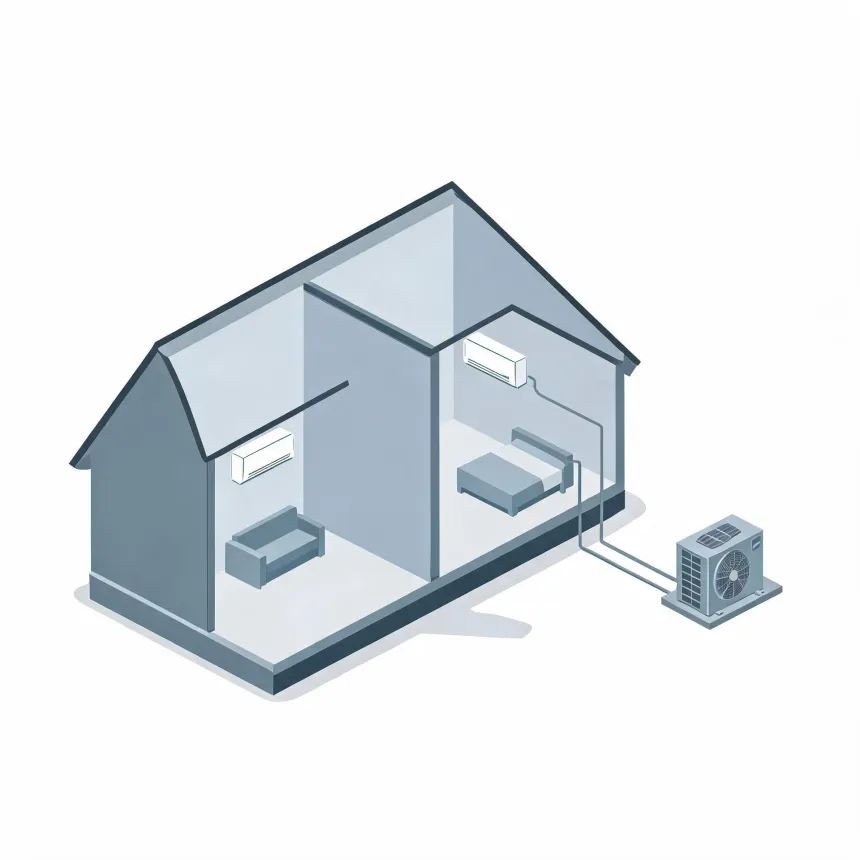
Isometric grey illustration of a cutaway house showing two rooms with wall-mounted indoor air conditioning units connected by lines to an outdoor condenser unit beside the building.
Your system heats September through May and cools July through August.

NOAA nClimDiv, 1991–2020 normals

New Hampshire electricity ran 23.40 cents per kilowatthour in 2024.

A mini split that's sized right for this home won't waste that rate on more capacity than the rooms need.

Most homes near Concord heat with oil, and a mini split is usually added alongside it, not instead of it

33.5% of homes heat with fuel oil
Climate zone 5A
Power costs 23.4 cents a kWh statewide
Sized for the room, not the houseHalf the homes in Merrimack County were built in 1977 or earlier, half later. Either way, the unit gets sized to the room.

Cooling here runs July through August, about two months. June is the month to get a mini split installed, before that first hot stretch hits. Do it in June and there's no rush job, no waiting on a contractor while the house sits uncomfortable. It also gives the system time to get tested and dialed in before you actually need it every day. Wait until July and the install happens the same week you wanted the relief.

Any mini split going in has to clear 14.3 SEER2 and 7.5 HSPF2

Merrimack County sits in climate zone 5A, where heating is the bigger job for most of the year. The federal standard treats a ductless mini split as a split system, so any unit made from 2023 on has to hit 14.3 SEER2 for cooling and 7.5 HSPF2 for heating. That sets the floor for what a contractor can install here, and a federal tax credit is available on top of it.

Find a contractor
A man in a cap, dusty dark shirt and work pants walks up stone steps toward a dark navy front door, carrying a worn canvas tool bag, with a potted shrub beside the entry.
A white outdoor air conditioner condenser unit mounted on metal wall brackets against gray horizontal siding, with a blue sky and white clouds behind it.

Two months of cooling a year, and mild at that

Two months of cooling a year is not much to ask of a compressor. July and August average a 79°F afternoon, not the kind of heat that pushes a system hard. The heating side carries more of the year here, and that's steady, moderate load rather than strain. A mini split in this county is more likely to show its age than show wear from hard running. When something does go wrong, it's usually worth fixing rather than replacing.

The number is a ratio, not a guarantee

SEER2 and HSPF2 compare output to the electricity a unit uses under fixed test conditions. A higher number means the compressor and coil squeeze more heating or cooling out of the same power draw. It doesn't promise a certain bill, because the test runs at set temperatures and the room it's cooling or heating never matches the lab exactly.

The rating only holds if the size is right

A unit rated higher can still run worse than one rated lower if it's the wrong size for the room. Oversized, it shuts off before it finishes pulling moisture out of the air, then kicks back on, burning power on restarts. Undersized, it runs flat out and never gets ahead of the load. The label only tells the truth once sizing is handled.

Sizing a mini split comes down to a load calculation, not a square footage chart. The contractor looks at how much wall and window area the room has, which way it faces, what's on the other side of the walls, and how much heat the room gains or loses through them. A room with outside walls on more than one side and a big window loses and gains heat differently than an interior room the same size. Insulation level changes the number too, and so does ceiling height. Skip that work and size off square footage alone, and the unit is usually wrong for the room. The calculation is what decides which capacity to install, and it has to be done before anything goes on the wall.

Install day starts with the indoor and outdoor units going in, and the line set connecting them through a hole drilled in the wall. That hole is small, usually just enough for the refrigerant lines, a drain line, and the electrical wiring to pass through together, and it gets sealed once everything's routed. The indoor unit mounts high on the wall, on brackets set into studs so it can carry its own weight. Outside, the condenser sits on a pad or wall brackets, away from anything that would block airflow around it. Once the lines are connected, the system gets evacuated with a vacuum pump to pull out moisture and air before refrigerant is ever released into it. Skip that step and moisture left in the lines can damage the compressor later. After that, the contractor charges the line, powers it up, and checks that it's cooling and heating the way it should before calling the job done.