Two white multi-story colonial houses with lit windows and black shutters photographed at night, fronted by a stone wall.

Mini Split Installation in Conway, NH

Tell us about the job

Takes about a minute. No obligation.

New system or replacementMini-splitCarroll County, NH
Step 1 of 2

What ZIP code is the job in?

How many zones you're conditioning

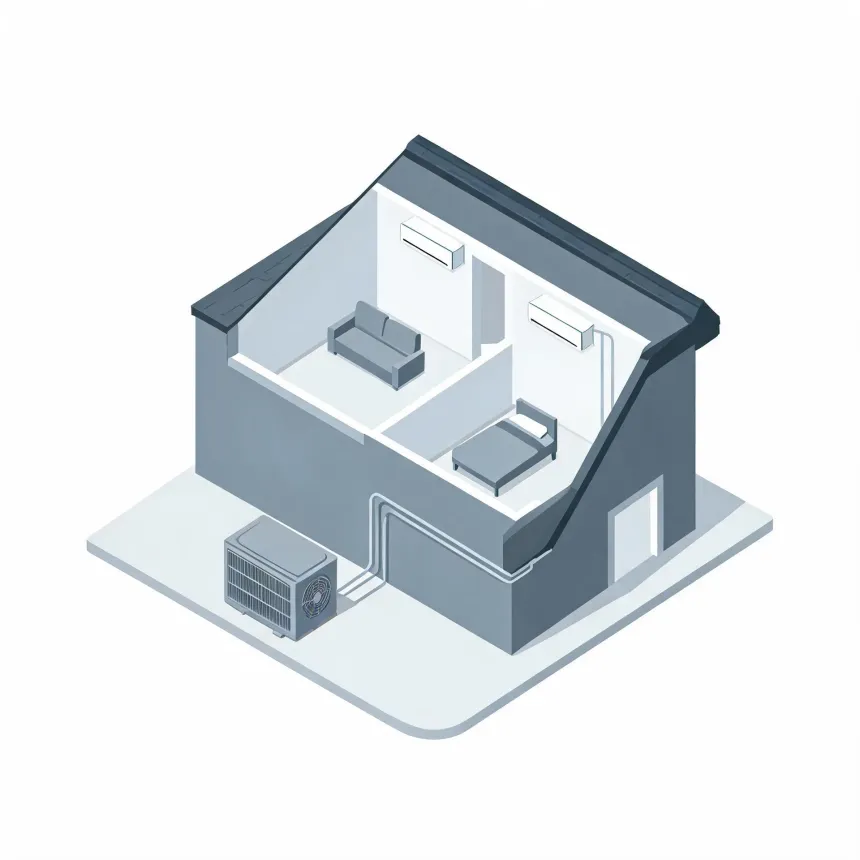
Each indoor head runs its own line set back to the outdoor unit, so a house needing heads in several rooms costs more than one needing a single head for an addition or a converted garage. The outdoor unit also has to be sized to handle all the heads connected to it, not just one.

Where the line set has to travel

The refrigerant lines run from the outdoor unit to each indoor head through a wall, and the distance and path matter. A straight shot through one wall is simple. Running line sets through finished ceilings, up multiple floors, or around framing takes more time and more material, and that shows up in the price.

9 months
September through May, your system heats
1 months
July through July, it cools
12°F
the average winter night it heats against
77°F
the average summer afternoon it cools against
Isometric cutaway illustration of a two-room house showing two wall-mounted indoor air conditioning units connected by line sets to an outdoor condenser unit on the ground outside.
Your system heats September through May and cools July through July.

NOAA nClimDiv, 1991–2020 normals

A mini split sized for New Hampshire winters handles Conway fine without upgrades.

There's no reason to pay for a bigger unit or higher efficiency than this job calls for.

Most of Conway heats with oil, and a mini split works alongside it

42.1% of homes heat with fuel oil
Cooling runs July through July
Summer afternoons average 77°F

Cooling in Carroll County only runs in July, one month out of the year. That's a narrow window, and it's exactly why waiting until July to install is the wrong move. A mini split going in during June, before anyone needs it running, gets installed without the rush of a heat wave or a backed up schedule. There's also no pressure to pick a system fast just to get cool air that day. Getting it in before July means it's tested and ready when the one month it has to work actually arrives.

Any mini split installed in Conway has to clear 14.3 SEER2 and 7.5 HSPF2

Carroll County falls under zone 6A, and any split-system heat pump manufactured from 2023 on has to meet 14.3 SEER2 for cooling and 7.5 HSPF2 for heating, ductless included. A federal tax credit is available on qualifying equipment. That narrows what belongs in this house to units that already clear the bar.

Find a contractor
A beige split-system air conditioner outdoor condenser unit mounted on metal wall brackets atop a stucco wall.

A light load most of the year

One month of cooling a year is light duty for a mini split. July afternoons here average 77, nothing close to the triple digit heat that wears a compressor down fast in other parts of the country. Heating runs long in Carroll County, but a mini split built for zone 6A is built for exactly that load. What ages a system here is usually time or a skipped filter, not the work itself. That's good reason to put money into keeping one running rather than replacing it early.

Ask for the heating output at low temperatures, not just the rating on the box

Every heat pump loses some capacity as it gets colder outside. The number that matters is what the unit can still put out at the coldest temperatures it will see, not the rating at a mild test temperature. A contractor who can show you that number has actually run the numbers for the job, not just picked a model off the shelf.

Ask who services it once it's in

A mini split needs its filters cleaned and its outdoor coil kept clear of leaves and debris. Beyond that, if the system loses refrigerant or a board fails, it needs someone who carries parts for that brand and knows the controls. Before buying, it's worth asking whether the installer stocks parts for the brand they're selling or whether a repair down the line means waiting on a shipment.

Sizing a mini split is a heat loss and heat gain calculation, not a guess based on square footage. A contractor measures the room or the house, accounts for window area, insulation, and ceiling height, and figures out how much heat it loses on the coldest day and gains on the hottest one. That number tells you what size head and what size outdoor unit the job needs. Oversize it and the unit short cycles, turning on and off fast without ever running long enough to pull moisture out of the air or settle into steady heating. Undersize it and it runs flat out on the coldest and hottest days and still can't keep up. Either way shortens the life of the compressor. A unit sized right runs long, steady cycles, which is both more comfortable and easier on the equipment.

Install day starts with the outdoor unit, set on a pad or wall bracket somewhere the airflow around the coil isn't blocked. Then comes the hole through the wall for the line set, usually one penetration per indoor head, patched and sealed once the lines are through. The lines get connected at both ends, and the system is pressure tested before any refrigerant moves, because a leak found after charging means recovering it all and starting over. Once the test holds, the lines get vacuumed down to pull out moisture and air, since either one left behind ruins the oil in the compressor over time. Only after that does the system get its charge and get powered on. A tech will run it in both heating and cooling before calling the job done, checking the temperature split at each head and confirming the outdoor unit cycles the way it should.