Most of Dover heats with oil
Fuel oil or kerosene heats 42.5% of occupied homes in Strafford County, more than any other fuel. Utility gas reaches 21.4% of homes, and electricity heats 12.1%.
Takes about a minute. No obligation.
Fuel oil or kerosene heats 42.5% of occupied homes in Strafford County, more than any other fuel. Utility gas reaches 21.4% of homes, and electricity heats 12.1%.
A mini split doesn't need to replace an oil furnace or boiler to be worth installing. It can take over heating and cooling for the rooms you use most, while the oil system stays as backup for the coldest stretches.
NOAA nClimDiv, 1991–2020 normals
Cooling runs about two months here, July and August, with afternoon highs around 79°F.
A mini split in Dover spends most of its life on heating duty, not AC, so that's the job to size it for.



Cooling in Strafford County runs July through August, so June is the month to get a mini split installed if that's part of the job. Waiting until July means putting it in after the first hot stretch has already arrived. A unit installed in June gets tested and running before it has to carry a summer afternoon. There's no equivalent deadline on the heating side, no single month that marks a cold snap the way July marks the start of cooling. But the unit still needs time to be set up and checked before it has to do either job.
Dover sits in climate zone 5A, where heating carries the bigger load. Any mini split installed here has to meet the federal minimum for a split-system heat pump. That's 14.3 SEER2 for cooling and 7.5 HSPF2 for heating. Equipment sold for this market is already built to that floor, and a federal tax credit is available toward the cost of a qualifying system.
Find a contractorTwo months of cooling a year is a light ask for any system. Afternoon highs around 79°F don't push a compressor hard, not compared to what units run in hotter parts of the country. That's the job this unit skips, not the one it's built around. Put the money into a reliable standard mini split rather than the highest SEER2 number on the shelf, and let it earn its keep on the heating side, where it works most of the year.
A mini split is matched to a space by working out how much heat that space loses in winter and gains in summer, not by square footage alone. Window area, how many exterior walls a room has, ceiling height and what's on the other side of each wall all factor in. Rooms the same size can need different capacity depending on those things.
A unit too big for the space cycles on, satisfies the thermostat fast, and shuts off again before it's run long enough to pull moisture out of the air or settle into steady airflow. That short cycling leaves a room feeling clammy in summer and swinging in temperature come winter, and it puts more wear on the compressor from starting and stopping than a correctly sized unit ever sees.
If the oil furnace or boiler is staying in, the old system doesn't go anywhere, it just takes on a smaller job. If a mini split is replacing an electric baseboard setup, whoever installs it can disconnect and haul away the baseboards once the new unit is tested and holding temperature on its own. Anything running on refrigerant, like an older heat pump or window AC being retired, has to be recovered properly rather than vented, since it's against the law to release refrigerant into the air. A fuel-burning furnace or boiler coming out for good needs its gas or oil line capped and the flue dealt with, not just unplugged and left. None of that work gets rushed on day one. Most of it happens after the new mini split has run through a full heating stretch and proven it's carrying the load it was sized for.
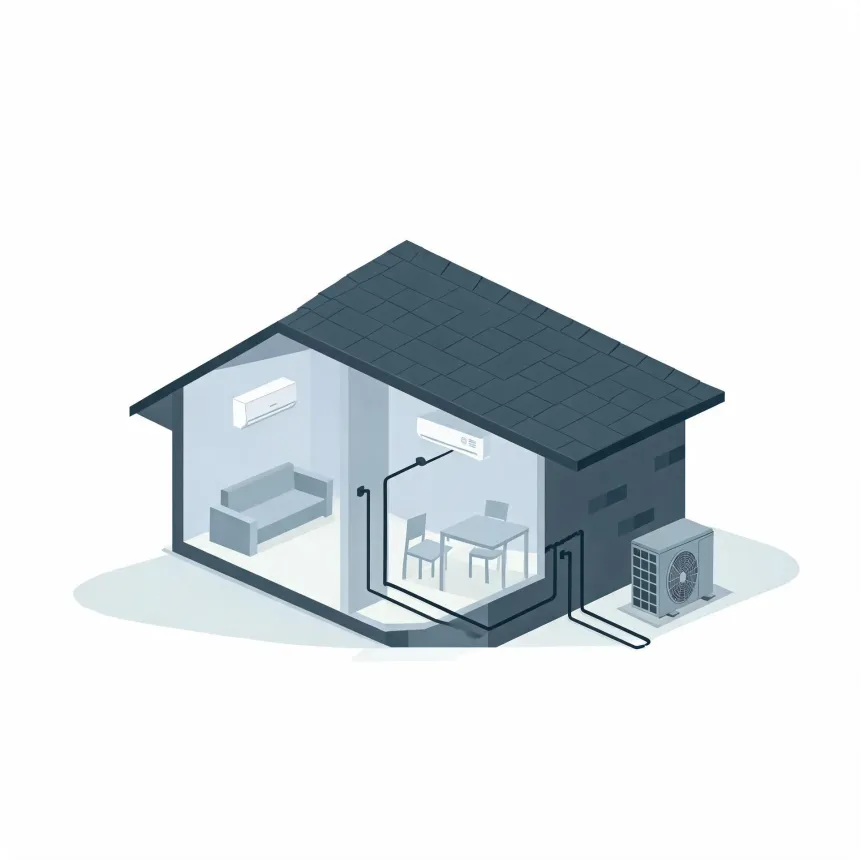
Installation starts outside, not in. The outdoor unit gets mounted on a pad or bracket with clearance on all sides so it can pull in air and shed it again, and the line set route from there to each indoor head gets marked out before anyone drills. That hole through the wall is small, just enough for the refrigerant lines, a drain line and electrical to pass through, but where it lands matters, since every bend in the line set after that is a bend the refrigerant has to move through. Once the indoor heads are mounted and the lines run, the system gets evacuated with a vacuum pump to pull out moisture and air before refrigerant goes in, because either one left in the lines will keep the system from working right down the road. Only after that does it get charged, powered up and run through both heating and cooling so it can be checked against what it's supposed to do.