A white wall-mounted split air conditioner on a blue-grey wall, with a moonlit night sky visible through a nearby window.

Mini Split Installation in Keene, NH

Tell us about the job

Takes about a minute. No obligation.

New system or replacementMini-splitCheshire County, NH
Step 1 of 2

What ZIP code is the job in?

A standard mini split handles Keene homes

Keene doesn't need an oversized mini split or a special cold climate model beyond what any contractor would already spec for New Hampshire winters. A correctly sized unit for the square footage you're heating and cooling will do the job.

Efficiency matters more than sticker price

New Hampshire homes paid 23.40 cents per kilowatthour in 2024, higher than a lot of the country. A more efficient unit costs less to run every month it's working, so it's worth comparing efficiency ratings between the systems you're quoted, not just the install price.

9 months
September through May, your system heats
2 months
July through August, it cools
15°F
the average winter night it heats against
78°F
the average summer afternoon it cools against
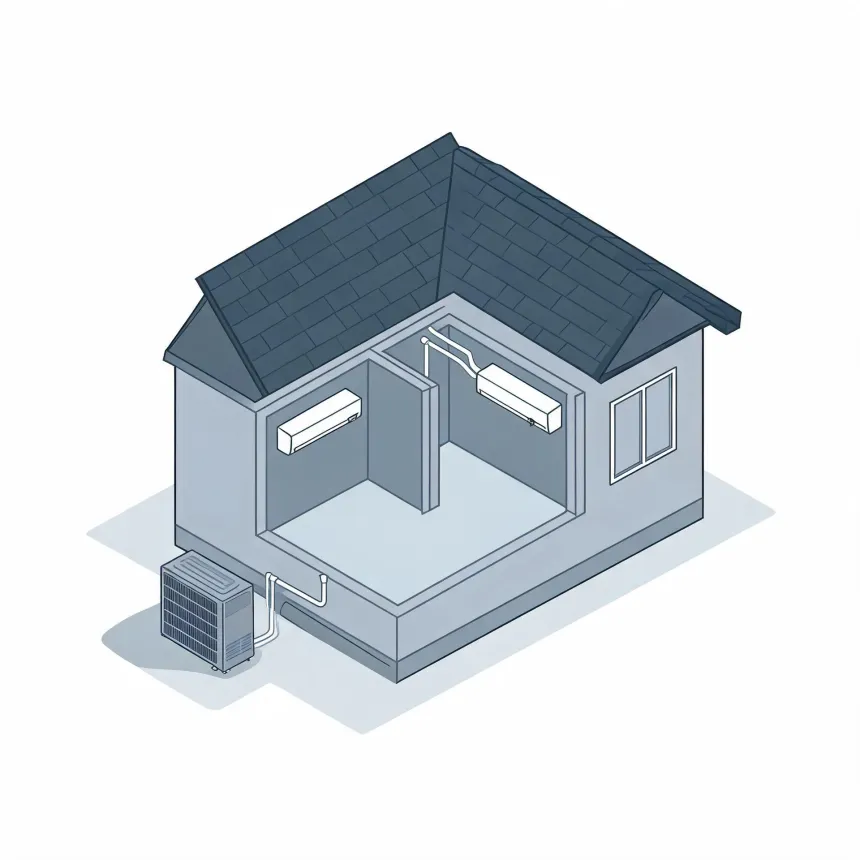
Isometric line illustration of a cutaway house with a shingled gable roof, showing two wall-mounted indoor air conditioning units connected by piping to an outdoor condenser unit on the ground outside.
Your system heats September through May and cools July through August.

NOAA nClimDiv, 1991–2020 normals

Cooling only runs about two months a year here, July and August, with afternoon highs averaging 78°F.

A mini split in Keene spends most of its life on light duty, so a reliable standard system holds up fine without reaching for extra cooling capacity.

Half the homes here were built by 1972, and a mini split has to work with the walls it's given

Half the homes here were built by 1972
Cooling runs July through August
Summer afternoons average 78°F

Most homes in Cheshire County heat with fuel oil or kerosene, 57.1% of them. Utility gas barely registers here, just 4.0%, so a gas furnace isn't the local default the way it is in other parts of the country. A mini split doesn't touch any of that. It runs on electricity and works alongside whatever is already heating the house, oil furnace or boiler included, rather than replacing it outright. For a lot of homeowners here that means the mini split handles the shoulder seasons and the two months of real cooling, while the existing system stays in reserve for the coldest stretches.

Get it installed before June runs out

July and August are the only months cooling really runs here, which means June is the last clear stretch to get a mini split installed before you need it. Book the install now and it's done on a normal schedule, not a scramble once the heat shows up.

Find a contractor
A white outdoor air conditioner condenser unit mounted on metal wall brackets against gray horizontal siding, with a blue sky and white clouds behind it.

Light duty means age and upkeep matter more than load

The compressor isn't working hard here, and most of the wear in these systems comes from running long hours against high heat loads, which Keene doesn't ask of it. That makes a straightforward repair a good bet when something does go wrong, since the parts underneath haven't been pushed. What catches up with a mini split here is usually age or a service that got skipped, not the two months of July and August asking too much of it.

The number of zones sets the price

A single indoor head paired with one outdoor condenser is the simplest job there is. Add a second zone, each needing its own line set and its own indoor head run through walls or floors, and the labor stacks up fast. A multi-zone system also needs an outdoor unit sized to run every head at once, which costs more than separate single-zone systems would.

Where the lines have to run decides the labor

A contractor has to get refrigerant line, drain line, and electrical from the outdoor condenser to every indoor head. If that run is short and goes through an easy wall, the job moves quick. If it has to cross a finished ceiling, drop through a floor, or snake around framing to avoid tearing into finished rooms, that's hours added before the system ever gets charged with refrigerant.

If this mini split is going in alongside an oil furnace or boiler rather than replacing it, the old system doesn't go anywhere. It just loses workload to the new unit. The furnace or boiler still needs its own service checks and still needs fuel delivered, same as before. Adding a mini split doesn't change the maintenance that system was already due for. Where full replacement is the plan instead, whoever handles the removal should cap the oil line and disconnect the flue properly, not just kill power and walk away. An oil system left partly disconnected is a worse problem than the one that started the job.

Install day starts with a walk through, confirming where the indoor head and outdoor condenser go before anyone touches a wall. The crew mounts the indoor unit, runs the line set, drain line, and electrical out to the condenser pad, then cuts a small hole through the exterior wall for the lines to pass. Once everything connects, the line gets evacuated with a vacuum pump to pull out air and moisture before refrigerant goes in. Any air or moisture left behind can damage the compressor down the road, so that step doesn't get skipped. After charging, the tech checks refrigerant pressure against the line length, tests the thermostat or remote, and confirms airflow and drainage are working before calling it done. A single zone with an easy wall run can wrap up in one day. Extra zones or a line set that has to cross a ceiling or floor push it longer.