Oil heats most homes here
Fuel oil or kerosene heats close to half the homes in Belknap County, more than any other fuel. Gas lines reach relatively few homes here.

Takes about a minute. No obligation.
Fuel oil or kerosene heats close to half the homes in Belknap County, more than any other fuel. Gas lines reach relatively few homes here.
A mini split doesn't connect to the oil system at all. It runs on electricity, so it can go into a home heated by oil, gas or anything else without touching the existing furnace or boiler.
NOAA nClimDiv, 1991–2020 normals
New Hampshire homeowners paid 23.40 cents per kilowatthour in 2024.
A standard mini split sized to the room keeps that cost in check. There's no reason to size up here.



Laconia only asks a mini split to cool for July and August, with afternoon highs averaging 79 degrees. That's a short stretch of real work, then the system sits idle the rest of the year. A standard unit sized to the room handles that without strain. There's no need to pay for a bigger compressor or a higher efficiency tier to get through two months of summer. Put that money into getting the size and the installation right instead.
A standard size and efficiency fit fine here. There's no local reason to go bigger or pricier.
Find a contractor
Two months of cooling a year is a light job for this equipment. The rest of the year it sits, so there's little wear to build up in the first place. Put the budget toward a correct size and a clean installation rather than a bigger compressor, and a standard unit will hold up fine on a two-month season year after year.
The distance between the outdoor compressor and the indoor air handler, and how many walls or floors the refrigerant lines have to pass through, decides how much labor the installation takes before anyone talks about the equipment itself. A straight shot through one wall is quick work. A run that has to go up through a soffit, across an attic, or down an exterior wall to reach where the compressor sits takes longer and uses more material, and that shows up in the price regardless of which unit gets installed.
A mini split needs a dedicated circuit, and whether the electrical panel already has room for one changes the job. If there's open capacity, running a new breaker and a line out to the compressor is straightforward. If the panel is already full, that's a separate piece of work to sort out before the mini split itself can go in, and it's worth asking a contractor to check this early rather than finding out partway through.
Sizing a mini split comes down to how much heat a room gains, not how big the room measures on paper. A contractor works through the walls, the windows, the ceiling height and which way the room faces, then runs those numbers to get a heating and cooling load. That load tells them which unit to install. Go too big and the compressor short cycles, blasting the room down to temperature and shutting off before it clears the humidity, so the air feels cool but damp. Go too small and it runs flat out on the hottest days and still falls short. The right size runs long, steady stretches at partial output, which is where these systems are most efficient and most comfortable. A room's square footage alone never gives you that answer, which is why a load calculation matters more than a guess based on floor space.
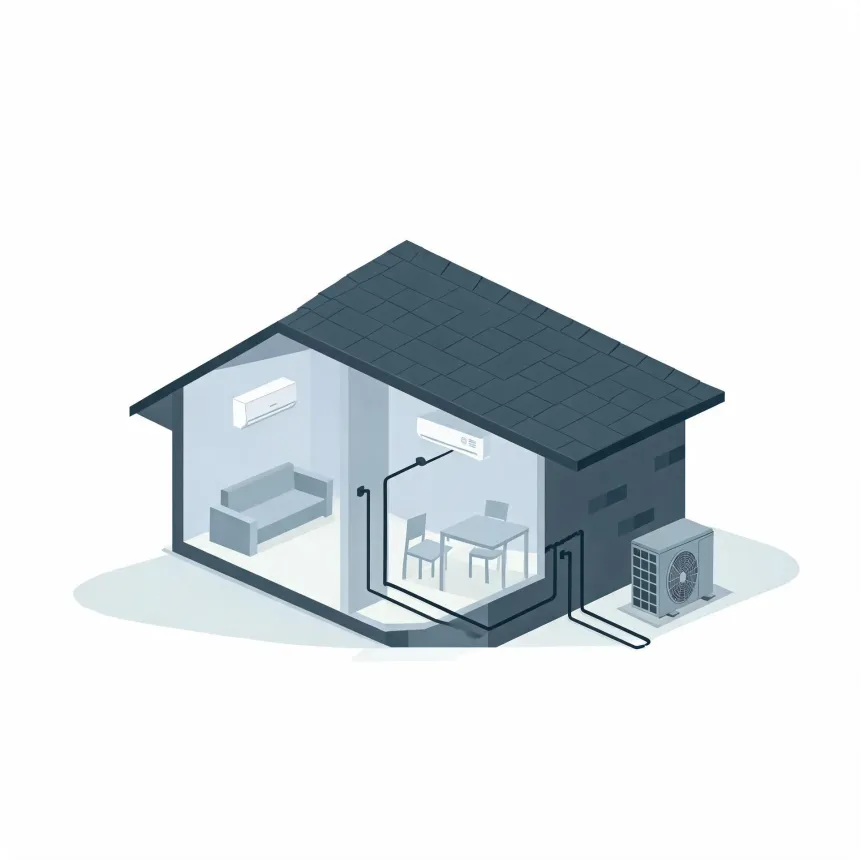
Installation starts outside, not in the living room. A contractor mounts the outdoor compressor on a pad or bracket, then picks a spot on the inside wall for the air handler, usually high up and away from direct sun or a heat vent that would throw off its reading. A small hole gets drilled through the wall to run the line set. That's the refrigerant lines, power cable and condensate drain, bundled together and wrapped. Once the indoor and outdoor units are connected, the lines get pressure tested, then a vacuum pump pulls the air out of them before any refrigerant moves through. Any moisture or air left behind causes problems in the compressor later, so a contractor won't skip that step to move faster. After that it's a power check, a run through each mode, and making sure the condensate drain slopes away from the house instead of pooling at the wall.