A gray cat sleeps curled up on a dark-made bed in a moody, minimalist bedroom with a wall-mounted air conditioning unit and warm accent lighting.

Mini Split Installation in Lebanon, NH

Tell us about the job

Takes about a minute. No obligation.

New system or replacementMini-splitGrafton County, NH
Step 1 of 2

What ZIP code is the job in?

Grafton County sees its share of storms

Grafton County logged 242 severe weather events between 2015 and 2024, with damaging wind the most common by far. An outdoor condenser needs a spot with some shelter from falling limbs and blowing ice, not just open air on all sides.

Power doesn't always come right back

Almost a quarter of New Hampshire households went at least a day without power in 2024. A mini split won't run without it, so if you're leaning on one for heat through the winter, ask about backup options before the install, not after the first outage.

9 months
September through May, your system heats
10°F
the average winter night it heats against
76°F
the average summer afternoon it cools against
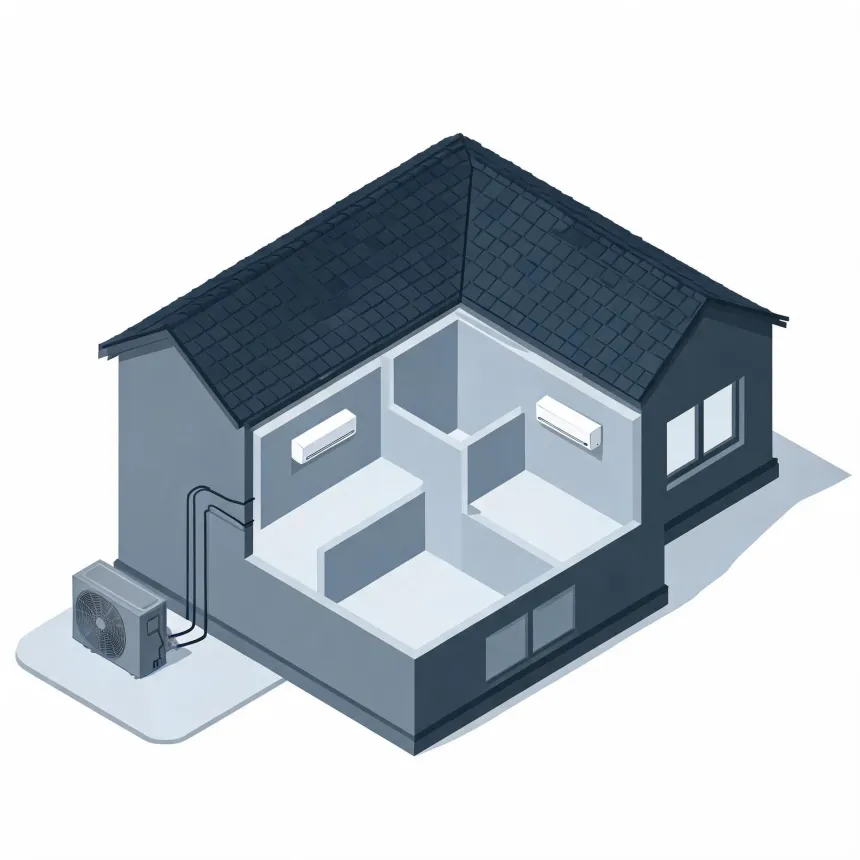
Isometric illustration of a cutaway single-story house with a dark shingled roof, showing two wall-mounted indoor air conditioning units connected by lines to an outdoor condenser unit on a pad beside the building.

Summer afternoons in Lebanon average 76°F, and June through August is about as much cooling as this place asks for.

Your mini split won't be working hard against the heat here, so you don't need to pay for the top efficiency model to get a reliable one.

Most homes here run on oil, and a mini split is usually added to that system, not a replacement for it

43.2% of homes heat with fuel oil
Summer afternoons average 76°F
133 damaging wind events from 2015 to 2024

Grafton County sits in zone 6A, the cold end of the code map. Any mini split going in here has to meet the same federal minimum, 14.3 SEER2 for cooling and 7.5 HSPF2 for heating. That rule applies to ductless units the same as any other split-system heat pump, there's no separate lower bar for them. You don't need to shop above that number. Cooling load here is light, so a unit at the minimum will keep up fine through the summer. Heating is where it earns its keep, through the long cold stretch this zone is built around. If a contractor quotes something below those numbers, it isn't a model you can install new here.

The standard size and efficiency works fine in Lebanon

A standard mini split, right at the federal minimum, is built for this. Electricity here runs 23.40 cents a kilowatt-hour, so what you pay to run it matters as much as what you pay to install it. Get the sizing and the spot for the condenser right, and a standard unit is the sound choice.

Find a contractor
A beige split-system air conditioner outdoor condenser unit mounted on metal wall brackets atop a stucco wall.

What happens to what's already there

This is an install, so there's an old system coming out, and what happens to it depends on what it is. If the house is heating with oil and the mini split is going in alongside it, that boiler or furnace isn't going anywhere. It stays as backup for the coldest stretches and keeps running the rest of the year the way it always has. If there's an older electric baseboard or an existing ductless unit getting replaced outright, that one gets disconnected and hauled off, lines recovered, refrigerant reclaimed rather than vented, since that's the law and good practice both. A straight swap is usually quicker than a first-time install because the electrical feed and sometimes the line set path are already there. The contractor doing the new work should tell you upfront which kind of job this is, replacement or addition, since it changes both the labor and what you're left running day to day.

Ask how they size the heating, not just the cooling

A mini split sized to cool your living room may not have enough capacity to carry it through the coldest nights. Ask the contractor to walk you through a load calculation for heating, not just a quick measurement of the room. The unit needs to match what the space loses on the coldest day, not just what it gains on the hottest.

Ask what happens below its rated temperature

Every heat pump has a point where its heating output starts to drop off, and a point below that where it stops keeping up at all. Ask the contractor what those numbers are for the specific model they're quoting, and what backup heat is supposed to carry the house when the air gets colder than that.

What drives the cost of putting one of these in has less to do with the unit itself and more to do with what it takes to connect it. The indoor head and outdoor condenser need a line set run between them, carrying refrigerant lines, a drain line, and electrical. The farther apart they sit, or the more walls and floors that line set has to cross, the more labor goes into that run. A straight shot through one exterior wall is a different job than routing lines up through a chase to a second floor. Multiple indoor heads off one outdoor unit add more line sets and more labor than a single zone. The condenser's mounting pad or bracket, and the electrical work to feed it, add to that same total. None of this shows up in the sticker price of the equipment. It shows up in what the installer has to do to make it work in your space.

Sizing a mini split starts with a heat loss and heat gain calculation on the room or zone it's serving, not a guess based on square footage. A contractor measures the windows, the exterior walls, the insulation, and works out how much heat that space loses on the coldest day and gains on the hottest. Too big and the unit short cycles, switching on and off before it's run long enough to dehumidify the air or settle into steady output. Too small and it runs flat out without ever catching up, which wears on the compressor and still leaves the room short of comfortable. A ductless system doesn't get to average things out across a house the way a central system can, so each head has to be matched to the room it's actually hanging in. The calculation also has to account for how that room is used, since a sunroom or a space with a lot of glass loses and gains heat differently than an interior bedroom of the same size.