A weathered white picket fence runs along a grassy lawn in front of a row of two-story wood-sided houses with porches and gabled roofs, beneath large leafy trees.

Mini Split Installation in Portsmouth, NH

Tell us about the job

Takes about a minute. No obligation.

New system or replacementMini-splitRockingham County, NH
Step 1 of 2

What ZIP code is the job in?

Weather here is hard on outdoor equipment

Rockingham County logged 103 damaging wind events and 29 hail events over the past decade, plus dozens of winter storms with heavy snow and ice. A mini split's outdoor unit sits through all of that, so where it mounts and how it's shielded from falling ice and wind-blown debris matters as much as the unit itself.

Power cuts last longer than people expect

22% of New Hampshire households went at least a full day without power in 2024. A mini split needs electricity to run, same as a furnace's blower or an electric water heater, so an outage takes out heat or hot water along with it. Worth asking your installer about backup options if that's a real risk for your home.

8 months
October through May, your system heats
2 months
July through August, it cools
18°F
the average winter night it heats against
80°F
the average summer afternoon it cools against
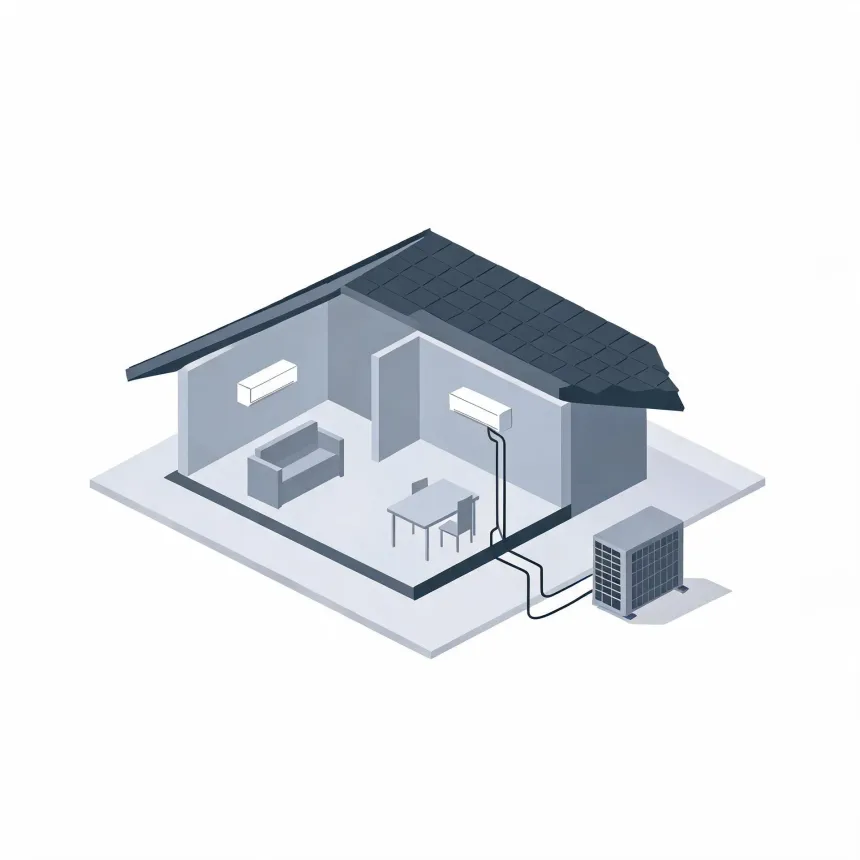
Isometric illustration of a cutaway house interior with sofa, table and chair, two wall-mounted indoor air conditioning units connected by lines to an outdoor condenser unit beside the building.
Your system heats October through May and cools July through August.

NOAA nClimDiv, 1991–2020 normals

A mini split system here doesn't need to be oversized to handle the heating and cooling load.

Put the money into a standard size done right, not extra capacity you won't use.

Most Portsmouth homes heat with oil, which is exactly why a mini split makes sense here

42.2% of homes heat with fuel oil
Cooling runs July through August
Summer afternoons average 80°F

Cooling here only runs July and August, about two months a year. June is a good time to get a mini split installed, before the first hot stretch and before installers get booked solid with emergency calls. Get it done in June and the system is tested and running right by the time you need it, not during the first heat wave when you're sweating out a wait for service. Oil heat doesn't give you any cooling at all, so if comfort in July and August matters to you, there's no reason to wait until you need it to get it in.

A mini split here has to meet zone 5A's efficiency minimum, and a federal credit applies

Rockingham County falls under zone 5A, where heating carries the bigger share of the work. Any mini split installed here has to meet 14.3 SEER2 for cooling and 7.5 HSPF2 for heating, the federal minimum for split-system heat pumps. That standard narrows down what an installer can offer you, and a federal tax credit is available on qualifying equipment.

Find a contractor
A man in a gray t-shirt and tan work pants, seen from behind, carries a canvas tool bag up wooden porch steps toward a dark blue front door beside a potted shrub.
A beige split-system air conditioner outdoor condenser unit mounted on metal wall brackets atop a stucco wall.

Two months of cooling a year, not the hard part of its job

Cooling runs two months here, July and August, with afternoon highs around 80. The rest of the year the outdoor unit is either off or working the heating side, which carries the bigger load in this zone. That's a short stretch of hard running compared to what the same unit would face further south. Less time spent fighting heat means less wear on the compressor and coil over the years. When a mini split here does need a repair, it's more often age or how it was installed than a system worn down from overwork.

Ask what size the load calculation came out to, not the guess

A mini split should be sized off a room-by-room heat loss and heat gain calculation, not a rule of thumb based on square footage. Ask the installer to show you the number and which rooms it covers. A system sized by guesswork either short cycles because it's too big for the space, or runs flat out and never quite catches up because it's too small.

Ask how many indoor heads the outdoor unit is rated to run

Multi-zone outdoor units have a limit on how many indoor heads they can support and how well they perform when more than one is calling for heat or cooling at the same time. Some systems lose capacity on each zone as more zones turn on at once. Ask the installer to walk through what happens if every room is running on the coldest morning of the year, not just how it performs with one zone on.

What drives the cost on one of these jobs is mostly what has to happen before the units go in. Running the line set and wiring from outdoor to indoor is harder when the path has to cross more wall, more floor, or framing that wasn't built with this in mind. A single zone with a short, straight run between units is simpler than a multi-zone system feeding heads on opposite sides of the house. The electrical panel matters too. If it already has room for a new circuit, that's one less thing to deal with. If it's full, the panel needs an upgrade before the mini split can go in at all. Where the outdoor unit can sit, and how much mounting or protection it needs, adds its own work. None of that shows up until an installer actually looks at the place, which is why a walk-through beats any estimate based on the equipment alone.

Installation starts with the walk-through findings, not a box truck showing up. The crew runs a line set between the outdoor and indoor units, a refrigerant line and a drain line, through a hole no bigger than a fist. The indoor head mounts on a bracket, the outdoor unit sits on a pad or wall bracket, and the lines connect through that one penetration. Once the lines are run and brazed, the system gets pulled into a vacuum to clear out moisture and air before any refrigerant goes in, and that step takes longer than most of the rest of the work combined. After that it's a charge check, a test run in both heating and cooling if the weather allows it, and a walk-through of the thermostat or remote before anyone leaves.